Six Hours of Sleep Feels Fine. Your Brain Disagrees.
Updated: May 19
I used to set four to six alarms.
Not because I was disorganised. Because some part of me knew, even before the day began, that getting out of bed was going to require more than one attempt. That the first alarm, the second, even the third – were just negotiations. The fourth was the ultimatum.
I thought this was normal. I thought this was what ambition looked like.
It wasn't. It was my brain waving a flag I had learned not to see.

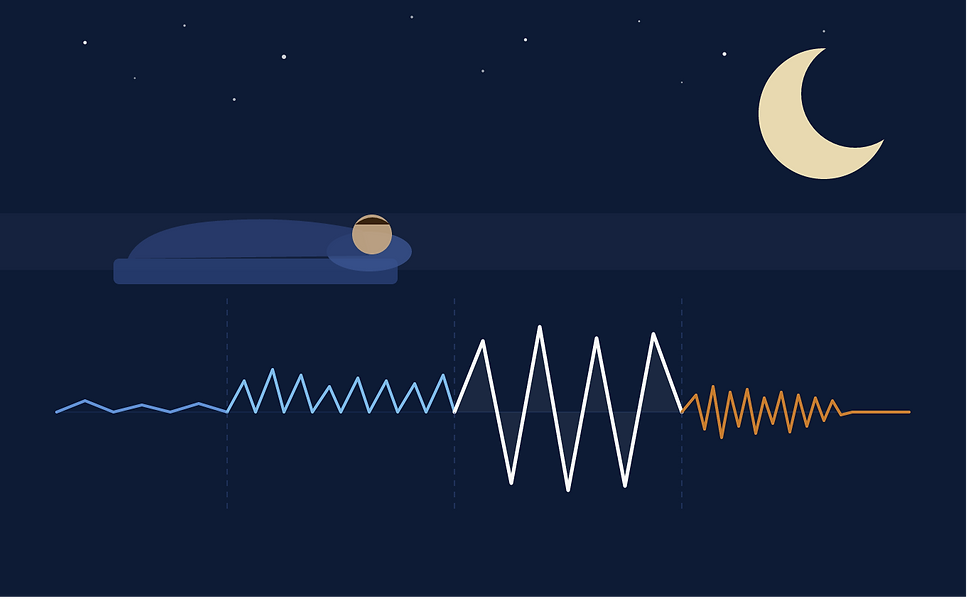
Here is something that took me a long time to understand: your brain does not rest when you sleep. It works. It clears toxic waste that accumulated during the day. It transfers everything you learned from fragile short-term storage into permanent memory. It regulates the hormones that control your mood, your appetite, your immune system, your ability to feel like yourself.
None of this is optional. None of it can be rescheduled.
When you cut your sleep from eight hours to six, you do not lose 25% of the benefit. You lose up to 60% of your REM sleep – the stage responsible for creativity, emotional balance, and the kind of thinking that makes you good at your job. The relationship between sleep and restoration is not linear. The loss is always worse than the arithmetic suggests.

There is a finding in sleep research that I think about often.
People who sleep six hours a night for two weeks perform as badly on cognitive tests as people who have been awake for 24 hours straight. Same scores. Same error rates. Same processing speed.
The difference is this: the people kept awake for 24 hours know they are impaired. The people sleeping six hours consistently rate themselves as only mildly tired.
The deprivation and the ability to notice the deprivation degrade at exactly the same rate.
You cannot feel how impaired you are. Because the part of your brain that would notice is the first part to go.

I am not writing this to tell you to go to bed earlier.
I am writing this because I spent years believing that the exhaustion was the price of ambition. That the fog, the forgotten words, the emotions that arrived too big and left too slowly – these were just the texture of a full life.
They were not. They were signals. And I ignored all of them, for long enough that ignoring them stopped being a choice.
The good news – and there is good news – is that the brain is more recoverable than most people think. Not perfectly. Not instantly. But substantially. The habits that protect sleep are not complicated. They are just consistently deprioritised in favour of one more hour of work that, in a sleep-deprived state, is worth about half of what it would have been rested.

One extra hour of sleep returns more than two hours of effective cognitive capacity the following day.
That is not a wellness claim. It is a measurable return on investment, demonstrated repeatedly in controlled research across diverse populations.
The most productive thing you can do tonight is go to sleep.
Your brain will do the rest.
If you want to understand what sleep actually does – and what losing it actually costs – the full guide is linked below.
Comments